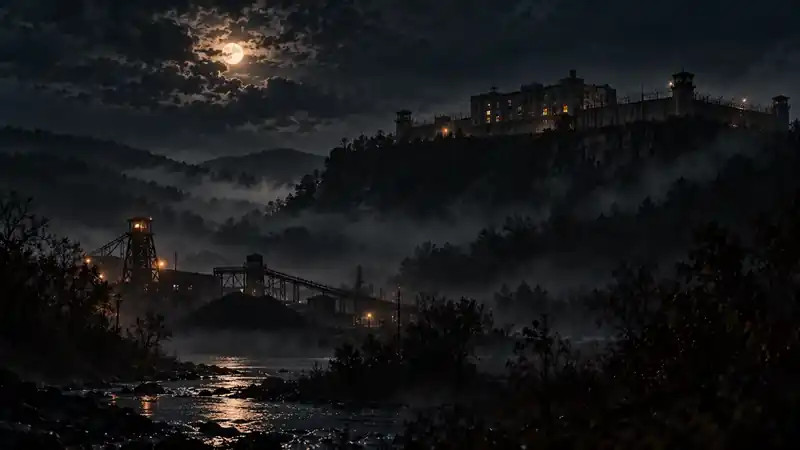
The story behind Brushy Mountain begins with coal, convict leasing and the Coal Creek War—not with a ghost hunt. Here is the dark history that shaped the prison long before paranormal tourism arrived.
Before Brushy, there was a fight over labor
The story that eventually produced Brushy Mountain State Penitentiary reaches back into Tennessee’s coal fields. After the Civil War, railroad growth increased demand for coal and mining communities developed around company-controlled housing and stores. At the same time, Tennessee and other Southern states used convict leasing, a system that sent prisoners—disproportionately Black men in the post-Reconstruction South—to private companies as a cheap labor force.
When mine operators brought leased prisoners into the Coal Creek area, free miners saw both their livelihoods and bargaining power threatened. The resulting Coal Creek War in the early 1890s included attacks on prison stockades, prisoners being placed on trains and sent away, and armed clashes involving miners and state forces. The conflict exposed the political and financial costs of maintaining the leasing system.
A prison built around state-controlled labor
Brushy Mountain’s own historical account connects the aftermath of the Coal Creek conflict to Tennessee’s decision to construct a state penitentiary associated with mining. Prisoners helped build infrastructure and worked in the mines. The institution that later gained a fearsome maximum-security reputation therefore began inside a much larger story about labor, race, punishment and the economics of industrial Tennessee.
That background matters when Brushy is discussed as a haunted place. The prison’s atmosphere was not created by a marketing department. Generations of incarcerated people lived through dangerous mining, disease, overcrowding, violence and isolation. Those facts deserve to remain visible even when the modern attraction offers paranormal programs.
Why Haunted Backroads starts with the record
Ghost stories are often the doorway that brings people to dark-history sites. The useful next step is to ask what happened there before the legend formed. At Brushy, the answer leads to the Coal Creek War, convict leasing and the complicated history of incarceration in Tennessee. That gives a visitor something deeper to carry home than a list of unexplained noises.
The conflict was never just miners versus prisoners
The Coal Creek story is easy to oversimplify into a dramatic image of armed miners freeing convicts from stockades. The deeper issue was a labor system that set groups of working people against one another while the state and private companies benefited from cheap prison labor. Free miners feared losing jobs and wages. Prisoners had almost no control over where they were sent or the conditions under which they worked. Race, class and punishment were tangled together.
That makes the episode uncomfortable in useful ways. The miners’ resistance helped weaken convict leasing, but the people leased into the mines were not the enemy. Many were trapped inside a post-Reconstruction justice system that criminalized Black Tennesseans disproportionately and then turned incarceration into a source of labor. A dark-history site should leave room for all of those truths at the same time.
Brushy Mountain carried the system forward in a new form
Ending private convict leasing did not end the idea that prisoners should supply labor. Tennessee shifted toward state-controlled prison industry, and Brushy Mountain became part of that transition. Inmates mined coal under state authority and lived in an isolated institution built into a mountain landscape that was difficult to escape and difficult for outsiders to see.
Over the decades, Brushy changed. Mining declined, security practices changed and the prison developed the maximum-security identity remembered by more recent generations. But the origin story matters because it explains why the prison existed where it did. Brushy was not placed in Petros because the mountains looked spooky. It belonged to the coal economy and to a specific argument over who would work the mines.
The ghosts came after the history had already become heavy
Modern visitors often first hear about Brushy through paranormal television, overnight investigations or stories about cells and corridors. There is nothing wrong with being curious about those reports. The mistake is letting the supernatural reputation replace the material history that made the place emotionally charged in the first place.
The prison is more compelling when the visitor knows why it was built, how labor shaped it and why isolation mattered. Then a cold corridor is not just a stage for an EVP session. It is part of a much larger Tennessee story about coal, punishment and the cost of industrial growth.
Sources and trip planning
Documented history, folklore, first-person paranormal reports and promotional claims are different categories. We keep them labeled separately and link practical visitor details back to current sources.

